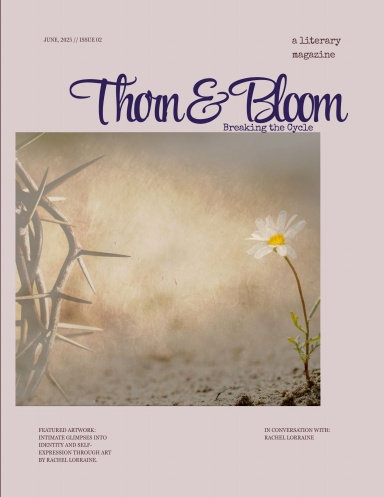
Creative Nonfiction published in ‘Thorn & Bloom’, Volume 2, 2025
“Body Language”
When I was forty, I understood my mother and father brought the war across the ocean and handed it down through their bodies. At eighteen, my father enlisted in the Royal Navy, served on a minesweeper stationed in the Mediterranean, was sprayed down with DDT triggering a protracted battle against the landmine of skin cancer. He spent much of his life steering clear of disruption, always avoiding, infrequently docking, never really resting comfortably against the shore of another. His hull of a body, reliable and predictable, and mostly impenetrable; his exterior, mostly calm, a remote greyish khaki was camouflage. While he avoided bombs, my mother needed to set them off, a reminder she was no longer evacuated far from home; she survived. The fumes of war smoldered at the edges of my childhood and lodged in the core of my movements. My mother feared lung cancer while other forms of unrest replicated inside. My father feared emotional connections, feelings and bonds which in forming demand the revelation of an inner self. Illnesses of the mind and the flesh formed my first language.
When I was thirty, my father moved in with us in a literal sense, though not really. He’d sit quietly reading the newspaper, leaving for months at a time, riding his bike across different countries. We’d see him leaving, then returning, always moving. Even stationary, he was miles away. He never said so, but I think my father’s motion kept him safe. Consumed with sustaining the form, he countered change, repelled aging, denied disease which was a question of will, a moral failing. A body trained to keep eyes forward, not looking back, and not looking here, now at the ground beneath his feet. He resisted rest which invites reflection; a terrible thing if one fears an emotional life, so he kept his body in motion. The war made him a sailor. The war made him an emigrant. After war, can anyone really return home to rest?
When I was twenty-four, I left the destruction of one home, and created another: I moved and and married. With restlessness by my side and discomfort in my body, my first husband suggested running and I decided on marathons thinking I could force my grandmother’s hips into an acceptable size. My mother called to tell me that he was a “Svengali”. She didn’t see the irony while he didn’t understand the slight. But he did understand that desirable wives are thin and not selfish, that running serves an aesthetic purpose. Finding or being or understanding my own body contributed nothing. And still, I feared some misinterpretation hidden inside. So, I followed my mother’s lead and left him.
With my parent’s battle beneath my skin, I kept running, a bodily rebellion in every foot falling against the unnatural concrete. I bought a necklace with 26.2 on the hanging pendant and wore it religiously thinking this devotional struggle would provide comfort. Until the cheap metal alloy tarnished, staining the skin above my heart while I failed to recognize the metaphor. Early morning runs grated against nature, each stride demanding, pushing, scolding my body to vanish along empty suburban sidewalks. I practiced conformity in each run, and once I had completed a marathon, I’d eat fries from a chip truck telling myself that I deserved them, that I had earned them. And I ignored the growing ache in my left hip.
When I was eighteen, my father demanded a degree so I moved into residence at the University of Guelph and started smoking. Not out of some rebellious streak. Instead I inhaled as a sort of benign assimilation into scene and circumstance, a way of breathing, a movement I’d learned. I joined friends whose svelte bodies moved next to mine wanting to look like them, to shrink my hips, and to quell my appetite. As a literature student, I wanted to craft my own manuscript of a dangerous life, unaware of the pantomime. Coffee and cigarettes were still cool back then. Food was optional, indulgent. Fat was imperfect, evidence of flawed character in the minds of working class parents born amidst air raids and rationing. They wanted a peaceful life with children who complied.
When I was seventeen, my mother sighed and I heard her whisper, “oh dear”, then watched her head drop with the realization that I had inherited my grandmother’s hips. I decided to forego breakfast and lunch, leaving only enough time in the day for dinner. Praise and attention were rewards for a body disappearing. My father has a polaroid photo of me in The Year of Great Deprivation on a suburban basement sofa, all outdated browns and beiges of the 1970s. I remember this scene – at the end of a school day, I had just come home, fallen forward, passed out, face down like a sideways semicolon. My father wordlessly snapped this photo pleased with this version of his daughter’s body. The photo froze a moment, unchanging other than the gentle fading of earthy hues, a form of devotion in capturing me unaware.
When I was fifteen, my mother packed up, left my father, my brother and me in the suburbs and moved downtown. Considered beautiful in the way of Elizabeth Taylor, my dark-haired, olive-skinned mother carried inner land mines of her own which exploded periodically whenever I stepped near her wounded parts. Evacuated to Wales as a child, she suffered a perforated ulcer at eighteen, and lived anxiously unaware, even to herself, when the next blasted ulcer of the mind would explode inside and make itself known to the outside. On weekends I’d take the bus and then the subway to the apartment she rented. Sometimes I’d have to knock and knock and knock on her door. I’d hear her stumble in her nightie to unlatch the chain on the locked door, and watch her body fall back into an overstuffed chair. She said, “I never should have left your father.” I scurried about recycling empty wine bottles, washing dishes, and emptying ashtrays forcing outward order to bring calm to the small space.
When I was twelve, my mother told me that she’d kill me if I ever took up smoking. This advice scratched against my throat while I breathed in her second-hand smoke and the threat. I think she held the habit to avoid gaining weight while fears of cancer diagnoses came periodically into conversations about the most recent lump she had discovered or the neck pain she felt upon waking. She still believed her words would carry a different weight with me and her body language didn’t matter. She believed those threats to health and all the reasons why I should not smoke would somehow inoculate me against the impulse. I didn’t want to smoke, but I inhaled the lesson and did anyway.
When I was six, I didn’t have to plan or think about eating or running or deciding how to move my body through life. I’d burst through the front door after dinner calling out as we climbed trees searching for friends playing hide and seek into the darkening night with the voice of my mother trailing behind demanding me to be “more lady-like”. The curves of the willow branches supported me while its tender boughs hid me from devouring eyes. Movement and motion flowed fearlessly with ease, without scripting. Breath merged with body untroubled, hunger grew naturally from abundance. The threats of war took up residence in tissues not yet fully developed, not yet exercised in the language of post-war life. I don’t remember getting explicit lessons for living in a body. Instead, I received covert messages about my body, about its utility for others, until later in life, when I noticed the ache in my left hip. My body had something to say.
When my body began to speak its own language, I had to listen. Language requires a speaker and a listener, a writer and a reader. I felt that mindless movement and compliance are like cancer cells growing restlessness. I could no longer ignore the increasing pain in my left hip with all its metaphor and symbolism. I researched the causes, read about the mechanics of this pivotal joint, and realized that running played a role in revealing the pain whose source originated in another country, in another time. My physical body needed rest while the war within needed resolution. Some spiritual traditions speak of left hip pain as the signal of unresolved mother issues or where the body feels stuck and cannot move forward. Running translated movements of my body. But, running failed to teach me how to move with my body, how to translate the language of my parents in my body. Raised in the body language of two WW2 survivors, I needed to discover my own way to move.
When I was fifty, I realized that I’d always felt the tug of writing, that translating life’s flow both physically and emotionally on the page had an allure, that writing brought some order to the mind. And, that order might contain past battles, some inner war yet unresolved making its way from the inside to the outside. It might contain hidden histories and unacknowledged harm. Now, with only the slightest flowing movement, I take my pen and begin. Here, all of it can be included, all of it can find its place in story. Here, I find the stillness, moments of reflection where inheritance forms the foundation of a story, where conscious movement and deep emotional connections allow me to write with the language of my own body.
.
 Site Title